Category: Blog Posts

  • Building a Sustainable Wardrobe

    Building a Sustainable Wardrobe

    Loading

    Author: Laura Evans

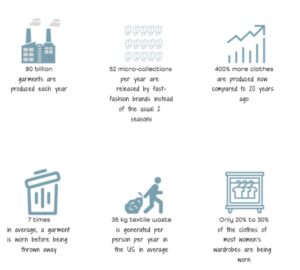
    Infographic via SustainYourStyle

    At the start of this month, the Environhawks delved into the world of fast fashion and how harmful it can be to both people and the environment. Overconsumption continually feeds the demand for both cheap labor and overproduction. Not only that, but garment production proves costly in terms of natural resources like oil and water. For example, “[n]early 70 million barrels of oil are used each year to make the world’s polyester fiber, which is now the most
    commonly used fiber in our clothing. But it takes more than 200 years to decompose.” (Conca, 2015). High levels of cheap, resource-demanding clothing being discarded directly into landfills where they do not decompose account for horrendous levels of water pollution, environmental pollution, and serious human rights violations in labor. If you’re a newcomer to sustainable living, vetting the clothing industry in search of an ethical source of clothing can be both
    intimidating and demoralizing. Today, I’ll be presenting ideas for where to get started on your journey to building a more sustainable wardrobe. Remember, it’s an ongoing process, not an overnight change.
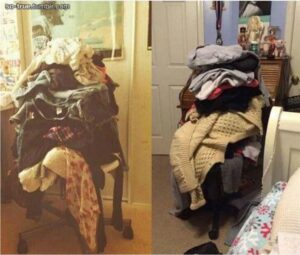
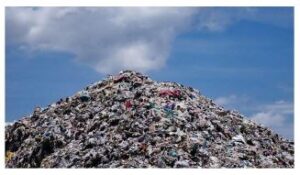
    The ocean has become the proverbial laundry chair of the world’s discarded clothing. However, it may prove a bit more difficult to clean up. Image via Ranker

    “Typically, for a garment to be considered ‘sustainable,’ it should be eco-friendly, ethically made, lasting, and accessible” (Costello, 2020).

    Preparation Is Key
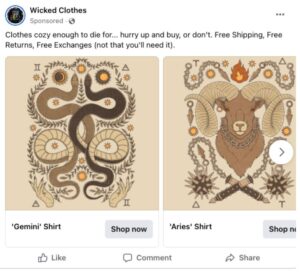
    Now, it may seem impossible to meet these “garment goals,” but a little forethought can go a long way. First, take your time and decide what statements you want your clothes to make: colorful or neutral? Textured or austere? Second, consider what pieces you need for your work environment or lifestyle. Blazers and slacks? Breathable athletic wear? Next, research “‘fit inspiration.” Rather than letting items choose you (think targeted facebook ads!), find clothes that speak to you.
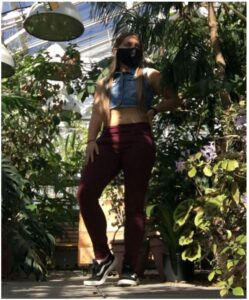
    I keep an ongoing list (and Pinterest board) of items I’d like to buy if I found them for a good deal. Rather than following the link from an ad or searching for an item on amazon, I play a waiting game. For instance, I had been searching for a pair of burgundy red jeans since I wore out the pair I had in high school. Finally, last year I found a pair in the thrift shop that matched my demands: the color, the stretchiness, the size.
    This brings me to the moment you’ve been waiting for: a purchase. Even with all your preparation, it’s important to take a moment before you buy. Think to yourself, “Is this piece functional? What can I wear this with? Do I really like this? Will I wear it often, or is it a one-event wear?” If you can “justify” your purchase, then the garment will likely serve you well
    for a long time.

    A Matter of Contention
    Thrifting is my favorite way to shop sustainably, but before I get to local recommendations, I want to address several valid points of criticism . Perhaps a thought bothered you the back of your head when I said I waited several years to find a pair of red pants: not everyone has time to wait that long; not everyone has time to go thrift shopping, period. It can be a time consuming process and typically requires filtering through an entire store’s inventory only to come out with 2 to 3 pieces. The process of going to a thrift store (or multiple thrift stores!) also requires mobility. Level of ableness can determine whether or not sustainable shopping is an option for some. Additionally, the availability of sizes varies
    dramatically, with “average” body type sizes dominating the selection. In short, a thrift shop rack often lacks inclusivity. It’s important to recognize sustainable shopping for everyone looks different, and resist the temptation to play gatekeeper when you notice someone has purchased fast fashion. Instead, continuing to invite people to the table no matter where they are in their journey toward sustainability is the best method to grow the sustainable fashion movement.

    Local Places to Go B(u)y
    Hold up–I’m not promoting buying anything you don’t need! However, if you’re searching for cheap clothing options there are several options in town. There are several consignment shops to check out like Revival, The Second Act, and The Savvy Boutique. However, my personal favorites are Goodwill and Artifacts. There are two Goodwill’s: one in Iowa City, one in Coralville. At the Iowa City Goodwill, I’ve found several quality items including a nice oversized suit jacket, and gray peacoat.
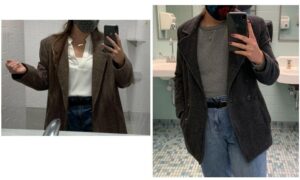
    At the Coralville Goodwill, I’ve found good athletic wear and belts. Goodwill prices generally cost less than $5 per item, which can’t be beat in my book! I find accessories like belts or jewelry can refresh your look without needing to buy new clothing.

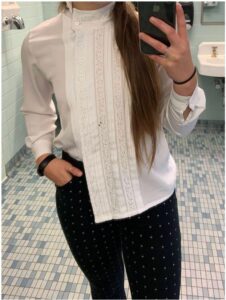
    Artifacts is an antique shop that also sells recycled vintage clothing. The cost is more in the $20-30 range, and I found this lovely white blouse (pictured below) for about $25 dollars at Artifacts. I’d been looking for a shirt similar to this for a dance performance, so when I found it, it fit my criteria of being an item I was searching for.
    A Final Note:
    I wish you well with your sustainable wardrobe journey. Feel free to comment below with your favorite local consignment store, or what your “wardrobe staples” are. If you have favorite blogs, youtube channels, or ethic fashion directories like this one, comment those as well! Thanks for reading, and be looking forward to our local business spotlight at the end of the month!

    References
    Conca, James. “Making Climate Change Fashionable – The Garment Industry Takes On Global
    Warming.” Forbes, Forbes, 3 Dec. 2015,
    https://www.forbes.com/sites/jamesconca/2015/12/03/making-climate-change-fashionabl
    e-the-garment-industry-takes-on-global-warming/?sh=4848c23079e4.
    Costello, Natalie Kay. “What Is Sustainable Fashion? | An Easy Guide for Beginners —
    Sustainably Chic.” Sustainably Chic, Sustainably Chic, 18 Jan. 2020,
    https://www.sustainably-chic.com/blog/an-easy-guide-to-sustainable-fashion-what-it-is-w
    hat-to-look-for-where-to-find-it.

  • A Brief Introduction to Fast Fashion

    A Brief Introduction to Fast Fashion

    Loading

    Author: Ashton Knatz

    Spring break is almost here! With the arrival of spring comes a fresh start and new beginnings. For some people, this might mean working on spring cleaning, healthier habits, or an overhaul of their wardrobe. Clearing out your wardrobe might encourage you to purchase new items to fill the vacant spaces, and it’s good to understand the possible implications of your clothing purchases, especially if they come from retailers like SHEIN, Forever 21, and ROMWE. These
    retailers are notorious for producing cheaply-made clothing that can come from questionable sources, which are the hallmarks of the fast fashion industry.

    Put simply, fast fashion is a term used to describe low-quality and inexpensive clothing that are mass-produced and cycled in and out of markets quickly to meet the demands of changing trends. The fashion industry has seen a major overhaul over the past two to three decades, which has seen a more demanding consumption of what is considered “new” and “trendy,” and a rejection of what is considered “old” and “outdated.2” With the emergence of social media
    platforms over the past couple of decades, trends are cycling through at faster rates than ever before. People are keeping their eyes on celebrities and influencers to see which new skirt to buy and which pair of jeans to trash. Influencers have taken to social media to promote their clothes from fast fashion retailers like SHEIN, which reaches millions of their followers and influences their purchases. SHEIN has become one of the most notorious retailers in recent years, and I’m going to discuss them in further detail.

    SHEIN (pronounced she-in) is a Chinese online fast fashion retailer that has become well-known for its remarkably low prices and wide variety of clothing. One tab on their website concerns social responsibility and their initiatives they are undertaking, and one of these is environmental sustainability. According to this section of their website, SHEIN claims to have invested in costlier thermal digital transfer and digital direct printing technologies in order to limit excess
    water use during production [1], but these statements are vague and do not offer any transparency. In addition, low-quality clothes are often made with synthetic materials, which are derived from fossil fuels. In the United States, 85% of our textiles end up in landfills, and since most of these textiles are made from synthetic materials, they do not degrade on a human time scale, which means they rapidly fill up landfills and create immense amounts of municipal waste [2]. Fashion is an interesting matter of debate because fast fashion practices contribute to not only environmental issues like increased waste, but also social issues. Many giant retailers still utilize sweatshop labor in certain countries, which often do not provide safe working conditions and ample pay for their workers, which is a human rights issue [3].

    The intersection of environmental and social issues perpetuated by fast fashion retailers is highly problematic. The domination of the fast fashion industry in the United States has led to problems, but there is hope with the emergence of more sustainable brands that take a “slow” fashion approach. In order to help combat the issues within the fast fashion industry, I would highly encourage you to limit your purchases from retailers like SHEIN. I understand that some
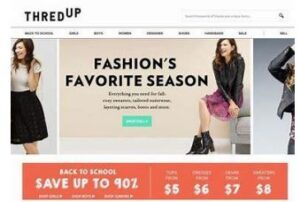
    people might need to purchase a few items from affordable retailers from time to time, and this is acceptable. However, if you are looking to change your wardrobe on a larger scale, I would encourage you to pursue sustainable shopping, such as thrifting or purchasing clothes from up-cyclers, such as ThredUp. This is a great way for you to make a difference on an individual level.

    Image Source: https://www.resellerratings.com/store/ThredUP

    Looking ahead to the rest of March, this blog will feature posts with tips on how to build a sustainable wardrobe, as well as an Iowa City small business feature. As always, if you have any questions about the content of this post, please feel free to leave a comment. Thank you so much for reading!

    Research Bibliography:
    [1]Sustainability & Social Impact | SHEIN USA. (n.d.). SHEIN. Retrieved March 3, 2022, from
    https://us.shein.com/sustainability-social-impact-a-1183.html
    [2]Schlossberg, T. (2019, September 3). How Fast Fashion Is Destroying the Planet. The New
    York Times. Retrieved March 4, 2022, from
    https://www.nytimes.com/2019/09/03/books/review/how-fast-fashion-is-destroying-the-planet.ht
    ml
    [3]Kozlowski, A., Bardecki, M., & Searcy, C. (2012). Environmental Impacts in the Fashion
    Industry: A Life-cycle and Stakeholder Framework. The Journal of Corporate Citizenship, 45,
    17–36. http://www.jstor.org/stable/jcorpciti.45.17
    Please note that I took the “Hello March!” image and the SHEIN logo from free image
    databases.

  • Local Sustainable Business Spotlight: Trumpet Blossom Café

    Local Sustainable Business Spotlight: Trumpet Blossom Café

    Loading

    Author: Laura Evans

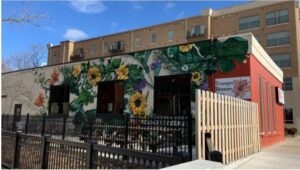
    To conclude the discussion of sustainable practices around food, the EnvironHawks chose to spotlight a local vegan restaurant; the Trumpet Blossom Café. Its owner and head chef, Katy Meyer, has a passion for creating delicious dishes using sustainable practices. Meyer is an inspiration both as a creator of tasty vegan meals, and as a female business owner. She sets an example of courage and tenacity for others to look up to as they consider stepping into the risky world of entrepreneurship. In the interview below, Chef Katy Meyer shares how Trumpet Blossom Café came into being, several ways her restaurant implements sustainable practices, and how community members can both practice sustainability and support local businesses who do!

    What’s the story of Trumpet Blossom Café?

    KM: I opened Trumpet Blossom Café as the sole proprietor in April 2012. Prior to that I was co-owner of The Red Avocado from 2005-2012. The Red Avocado was a vegan restaurant in Iowa City; I was a chef and co-owner but was not one of the founding owners. It was open from 1999-

    2012 and we had to close in January 2012 because the building we were in was sold and torn down (it was in a house on Washington St. where the building that DP Dough is currently.) My business partners wanted to do other things, and I wanted to continue in the industry so I secured a new location and opened Trumpet Blossom Café as a full service restaurant, bar, and venue three months after The Red Avocado closed.

    What does sustainability mean to you?

    KM: Sustainability, within a business model, is operating by making conscious decisions taking into consideration more than just the bottom line. It is a way of doing things that is gentler on the environment and more harmonious with the physical and social surroundings in which the business exists. I believe we each have a responsibility to do what we can with what we have to make where we are better. And if one chooses to run a business then this belief extends to the operations of the business.

    What kind of sustainable practices have you implemented at your business?

    KM: We don’t use any animal products in our restaurant so that choice alone is far more sustainable than choosing to use animal products. We recycle everything that is recyclable. We compost all our food waste and all other compostable material. We use compostable to-go containers and utensils. We try our best to not add to the ridiculous amount of waste that can be generated in the commercial food industry. There is no way we can continue, as a society, to operate the way we have and expect future generations to have a safe and healthy place to live.

    Do you locally source your business’ food?

    KM: We source local ingredients seasonally when possible from several local producers. The shorter distance an ingredient has to travel to get here, the fresher it is and the better it tastes. We support growers who use organic practices and this means the food is more nutritious because the soil it grows in is healthier since it’s not bombarded with chemicals.

    Do you have advice for people who would like to eat more sustainability or make their business more sustainable?

    KM: If anyone is interested in eating more sustainably or operating their business more sustainably there is a wealth of information on the internet regarding advice and resources for

    making more sustainable choices. Eat with the season and eat more plants are the two best pieces of advice for making a diet more sustainable. Aim for change, not perfection. Make business decisions by taking all facets of the outcome into consideration, including the health of your customers, co-workers, and environment.

    Did you have any role models when you opened Trumpet Blossom Café?

    KM: I didn’t have any specific role models or influences when I opened my business. I trusted my instincts, was stubborn enough to do something really risky, and I felt very supported by my community as a whole, and fortunately I still do.

    How were you affected by the pandemic?

    KM: The pandemic shut my business down completely from mid-March to early May 2020. We had zero dine-in customers for an entire year—May 2020-May 2021. My revenue was cut nearly in half in 2020. Even now, the majority of our sales are still to-go orders. I had to change my menu to accommodate items being put in boxes instead of on plates. My staff changed, my schedule changed, every decision I made was influenced by forces completely out of my control and we had to manage every situation with an undertone of uncertainty which did not exist prior to March 2020. Running a restaurant these past two years has been more stressful and unpredictable than I ever could have imagined. But we’re still here so I guess that’s something. Obviously, we owe our success to the support of our community.

    How can members of the Iowa City community better support local businesses like Trumpet Blossom Café as they practice sustainability?

    KM: If someone is interested in supporting businesses that practice sustainability they need only call or email with questions before they spend their money there. Ask the people in charge what their sustainability practices are and how they are working to improve any areas where

    improvement can be made. Keep in mind that it’s nearly impossible for a small business to be perfect—there are always obstacles and setbacks and owners are constantly having to shift their methods to fit new and changing situations. But it should be pretty clear if they care or not.

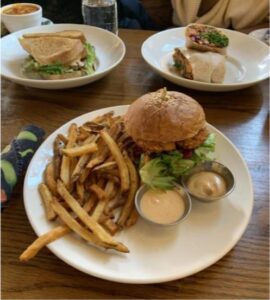
    After hearing Chef Meyer’s responses, the line that stood out the most was “Aim for change, not perfection.” Sustainable practices ought to be, well, sustainable, and her advice reflects that sentiment. Trumpet Blossom Café has fought through difficult barriers, and yet continues to thrive in the Iowa City community thanks to its capable owner. Offering a menu of delicious vegan and gluten-free dishes, appetizing sides, and fun drinks, Trumpet Blossom Café provides the perfect local outlet to support in your journey toward more sustainable eating.

    Watch: My visit to Trumpet Blossom Café