
Author: Ashton Knatz | Latham Science Engagement Initiative
I am pleased to write our final blog post for the EnvironHawks project for the Latham Science Engagement Initiative this year. Our blog has covered a wide variety of topics pertaining to the environment and sustainability, including food sustainability, fast fashion, and local initiatives. Our previous blog posts for this month discussed the One Sustainable Iowa Student Conference, as well as different opportunities to get involved with environmental legislation. For my post this month, I wanted to write about more environmental initiatives happening at the University of Iowa, including environmental research. I had the pleasure of talking with Dr. Hans Lehmler, a professor conducting research in the Department of Occupational and Environmental Health at the University of Iowa. Dr. Lehmler’s primary research focus is on the human and environmental effects of BPA and BPF. According to PubChem, BPA is a colorless solid that is used in the synthesis of commercial plastics, and BPA is considered to have carcinogenic effects, which means they can be linked to cancer. BPA exposure has also been linked to endocrine disruption.
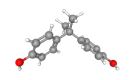
BPA’s 3-D structure. Image Source: https://pubchem.ncbi.nlm.nih.gov/compound/bisphenol-A#section=3D-Conformer
“There are a number of adverse health outcomes that are associated with Bisphenol A exposure in humans. This largely has to do with the fact that these chemicals are behaving like hormones in the human body… These are not hormones, but they do what hormones are supposed to be doing, which can lead to toxicity. That’s what we call endocrine-disrupting chemicals, because they are messing with our endocrine system. This is implicated in any disease where the endocrine system could potentially play a role, whether this could be metabolic syndrome, or it could be implicated in cancers, and other disease outcomes as well.”
A lot of plastic products now have labels that say “BPA-Free,” and several stores have voluntarily stopped carrying products with BPA in them, including Walmart. However, this does not necessarily mean that compounds that are similar in structure and function to BPA have completely gone away.
“When you go into stores, you find advertisements that products are BPA-free, but what typically happens is that the BPA has been replaced with something else, and that something else looks very similar to the BPA. There are dozens of these chemicals being used… such as Bisphenol F, S, and others.”
While products may have a “BPA-free” label, there aren’t necessarily strict regulations on which compounds can be used in these products, as well as how much of a compound may be used. In order to avoid BPA exposure from plastic products, there are a few precautions you can take. Using food storage containers as an example, one thing you can do is use glass containers to store food, rather than plastic containers or bags.
“I think the best approach if somebody has a concern of BPA exposure would be to avoid plastic materials and use glass or metal containers that do not have these chemicals in them. This essentially reduces the exposures. It also has another advantage that if you’re doing this, you have a glass or metal container that you can reuse, which is better for the environment, rather than throwaway plasticware.”

In addition to his work as a professor and researcher, Dr. Lehmler also works with the Iowa Superfund Research Program, which works to find sources of airborne PCBs and the effects that they have on the human body. According to the CDC, PCBs (which is short for polychlorinated biphenyls) are a group of synthetic chemicals that do not have a known smell or taste, and may range from being oily liquids to solids, as well as from being colorless to light yellow. PCBs have a number of different human and environmental health effects, and do not readily break down once they enter the environment, so they can remain in environmental systems for a long time. I was curious about Dr. Lehmler’s involvement with the Iowa Superfund Research Program, and he told me about the work he does with PCBs with this program at Iowa.
“PCBs have been around for about 50 years, and we have known that they are an environmental pollutant, and there are concerns associated with them. There are still a lot of fundamental things that we do not know about PCBs, and we do not have data as a society to do a risk assessment that is based on solid data. In particular, we do not have data on the inhalation of PCBs into your lungs and when they get into your body and do harm there.”

The general chemical structure of PCBs. Image Source: https://www.researchgate.net/figure/General-chemical-structure-of-PCBs_
“For a long time, the focus was on understanding the PCBs that are in your diet, such as fish. The fish may come from a creek that has PCBs in it because somebody dumped them in there. For a few decades, the major route of exposure would be from eating PCBs, but we know now that there are PCBs in the air, so people are breathing them. Because we understood that these chemicals are a problem, we stopped making them, we’ve cleaned things up, and we’ve disposed of them properly as a society. The dietary route of exposure has actually gone down, and this is on par with what people are breathing in.”
Dr. Lehmler has done a significant amount of work pertaining to environmental toxicology and human health over the past several years. He also works closely with CHEEC, which is the Center for Health Effects of Environmental Contamination at the University of Iowa. There are a number of other research projects and opportunities happening through CHEEC as well, and so I have linked their website here: https://cheec.uiowa.edu/about.
I was very pleased to have had the opportunity to talk with Dr. Lehmler and hear about the work that he has done at the University of Iowa. We have talked a lot about events and initiatives through the Office of Sustainability here at Iowa, but there are also a number of environmental research opportunities across campus as well. Iowa is a Research 1 university, which means it has been designated as a top tier doctoral university with high research activity. As such, there are a lot of opportunities for students to get involved. If you are interested in environmental research, I would encourage you to reach out to your professors or other people to hear more information.
Thank you again to everyone that has engaged with the EnvironHawks blog in some way. I hope you have learned a lot of useful information about the environment and sustainability through our blog. We encourage you to reach out to us if you have any additional questions about our blog or want to learn any more information on the topics we have discussed. Thanks to all of you again!
References
1. National Center for Biotechnology Information (2022). PubChem Compound Summary for CID
6623, bisphenol A. Retrieved April 25, 2022 from
https://pubchem.ncbi.nlm.nih.gov/compound/bisphenol-A.
2. CDC. (n.d.). Polychlorinated Biphenyls (PCBs) | Public Health Statement | ATSDR. Agency for
Toxic Substances and Disease Registry. Retrieved April 22, 2022, from
https://wwwn.cdc.gov/TSP/PHS/PHS.aspx?phsid=139&toxid=26